What Did This War Bring China? | Shenzhou Dadi Ep.31 · 神州大地 · 第一季
章节
👁 1 次观看
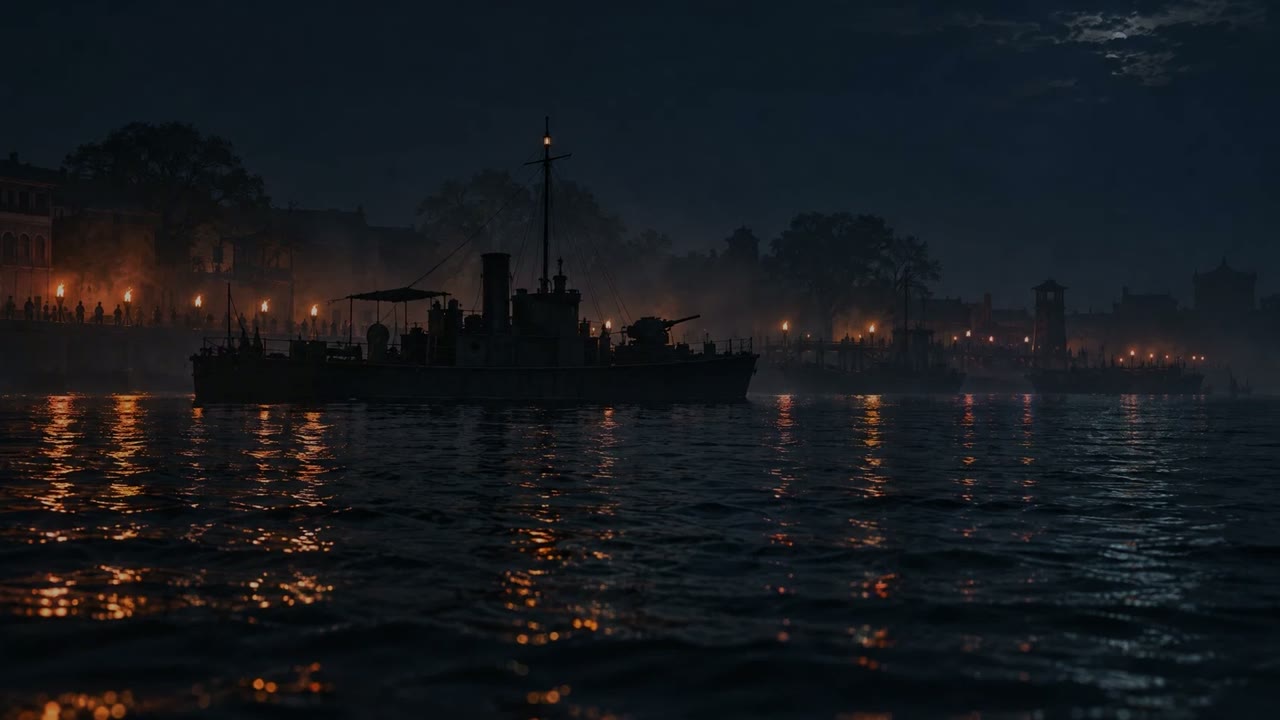
The wall was not breached; it was opened from inside.
In 1926 the same war carried four names: the Northern Expedition in the south, the Southern Campaign in Beiyang telegrams, the North–South War in the neutral commercial press, and a duel between old and new ideas among intellectuals. From the oath at Guangzhou's East Parade Ground in July to the opening of Wuchang's gate three months later, the armies moved north along the Yuehan railway.
This episode follows that line: the temples and towers of Guangzhou, the academy and the lake country of Hunan, the bridges of Xianning, and the towers of Wuchang. Poems appear on screen in full, with variant readings side by side. What the July manifesto promised — a national assembly, a unified government, an end to the unequal treaties — is set beside the military notes, the rice accounts and the grain inside a city under siege. Both columns are shown; no verdict is added.
Official website: sylogs.com
#NorthernExpedition #Wuchang #ChineseHistory #RepublicOfChina #HistoryDocumentary #ShenzhouDadi
⏱ Chapters
0:00 Cold open: the gate opened from inside
0:05 Title card
0:16 Act I - Four names for one war
8:24 Act II - The same July
19:34 Act III - Bridges and accounts
25:52 Act IV - Before Wuchang
30:05 Act V - Words on paper, things on the ground
35:11 Epilogue
视频全文转录
The wall was not stormed. Its gate was opened from the inside.
Shenzhou Dadi, Episode Thirty-One. What did this war bring China? The rights and wrongs of the so-called Northern Expedition.
In the south it was called the Northern Expedition. In Beiyang telegrams, the Southern Campaign. The commercial press, claiming neutrality, mostly wrote of a North-South War.
Beyond the East Parade Ground, this city is layered with older dynasties.
Guangxiao Temple stands on the former palace of Zhao Jiande, king of Nanyue under the Western Han. Under the Wu of the Three Kingdoms, the classicist Yu Fan taught here for thirty years, and the place was called Yu's Garden. In the Eastern Jin a main hall rose; in the Southern Dynasties Bodhidharma opened the Wash-Bowl Spring.
People in Guangzhou still say: before there was a City of Rams, there was Guangxiao.
Six Banyan Temple dates to the third year of Datong under the Liang, in 537, when the governor Xiao Yu built a pagoda for relics and Emperor Wu gave it the name Baozhuangyan. In the early Tang, Wang Bo came south to visit his father.
In 1100, Su Shi, pardoned and travelling north, passed through Guangzhou, saw six old banyan trees and wrote the two characters Six Banyan. A couplet still hangs at the gate: one pagoda keeps a stele by a scholar.
Further east, in 594, the fourteenth year of Kaihuang under the Sui, the Temple of the South Sea God was raised at the mouth of the Pearl River, honouring Zhurong, god of the southern sea - the only one of China's four great sea-god temples still standing.
In 1591 Tang Xianzu, exiled to Xuwen, passed here and wrote three poems on the Boluo Temple. At the god's birthday the temple fair begins: villagers row in from four districts, selling Boluo dumplings and incense. The fair is still held today.
On Yuexiu Hill stands the Zhenhai Tower, built in 1380 when the Marquis of Yongjia, Zhu Liangzu, extended the Guangzhou walls. Also called Sea-Viewing Tower, or simply the Five-Storey Tower, it has been destroyed and rebuilt five times.
Kang Youwei climbed it and wrote of mounting a tower into mist, of wind rising and clouds flying over the nine provinces. Li Diaoyuan wrote that he did not know how wide the sea was, only that the green hills seemed to float. Before it stands the Temple of the Five Immortals, from 1377, honouring the five riders who brought grain on rams.
The Chen Clan Academy, begun in 1890 and finished four years later, was built by Chen families from seventy-two counties of Guangdong. Wood carving, brick carving and plasterwork lie layer upon layer.
Through those three months, Guangzhou kept its routines: a pot of tea and two dishes of dim sum at the tea house from dawn to noon; lychees in season; and Su Shi's poem on Lingnan, with its line about eating three hundred lychees a day and staying on as a man of the south.
In July the East Parade Ground held an oath-taking; west of the city the tea houses were still full.
Four days after the name was settled, the paper was ready too.
From the fourth to the sixth of July 1926, the Central Executive Committee of the Nationalist Party met in emergency session in Guangzhou and formally decided to march.
The declaration addressed the nation with three claims: it traced China's suffering to imperialism and the warlords; it said the one need was a unified government; and it spoke of a national assembly and an end to the unequal treaties.
This declaration was issued to give the march a name and to claim legitimacy. It was neither a military order nor a contract. The national assembly, a unified government and the ending of unequal treaties were all promised on paper. None of them came about.
On the ninth of July there was also an oath by Chiang Kai-shek on taking command, four characters to a line, beginning with a call to his officers and ending with the impartiality of military law. A circular telegram went out the same month. Both belong to the same class of propaganda.
On the first of July the National Government issued mobilisation orders; from the fourth to the sixth the emergency session decided on the march and passed the declaration; on the sixth the general headquarters was set up; on the ninth, the oath. Four dates.
Two days later, on the sixth, the National Revolutionary Army's headquarters opened in Guangzhou, with Chiang Kai-shek as commander-in-chief. Three days after that, at ten in the morning on the ninth, the East Parade Ground.
The ceremony is recorded action by action: Tan Yankai, for the National Government, presented the seal; Wu Zhihui, for the party centre, presented the flag; Chiang received both, then spoke.
Eight armies marched: the First under He Yingqin, the Second under Tan Yankai, the Third under Zhu Peide, the Fourth under Li Jishen, the Fifth under Li Fulin, the Sixth under Cheng Qian, the Seventh under Li Zongren, the Eighth under Tang Shengzhi.
Who would be struck first was settled at the parade: the first name in the declaration was Wu Peifu, whose troops were pressing into Hunan, where Tang Shengzhi had just come over.
Take the two lakes first, and the Yuehan railway supply line could push north. So the blade fell westward: Wu first, Sun later, Zhang last.
The eight armies did not set out together. The Independent Regiment of the Fourth Army went ahead into Hunan in May; the Seventh and Eighth joined it there; the rest went north in stages.
On the twenty-seventh of July Chiang left Guangzhou. On the evening of the eleventh of August he reached Changsha.
The eleventh of July. Changsha.
The route north ran through southern Hunan: the Independent Regiment ahead in May, holding Anren, Youxian and Lutian; Hengshan in mid-June; Changsha on the eleventh of July; Yueyang on the nineteenth of August.
On the twelfth of August a military conference in Changsha chose Wuhan first and a holding posture in Jiangxi.
The supply line followed the same path: the Yuehan railway north, with the water network of Dongting and the Han river alongside. Grain, ammunition and porters moved forward from one rail stop and wharf to the next. On the docks of Hunan and Hubei, the paperwork piled up.
The rice-noodle stalls of Changsha stayed on the pavement; fish still came out of the river at Wuchang. Only the people holding the bowls changed, again and again, through those three months.
Every place the army passed had a name older than the war.
On the west bank of the Xiang at Changsha stands the Yuelu Academy, founded in 976 under the Northern Song and given its plaque by Emperor Zhenzong in 1015. It ran without a break through Song, Yuan, Ming and Qing. Its gate couplet says: Chu has its talent; here it flourishes.
In the Jiaqing years the headmaster Yuan Mingyao set the first line, and a student, Zhang Zhongjie, answered it on the spot. In 1167 Zhu Xi and Zhang Shi met to lecture in its hall, and students came from all over.
In 1938 that couplet was destroyed by Japanese bombing; the one hanging today is a 1984 copy made from old photographs.
Behind the academy, in 1792, the headmaster Luo Dian built a red-leaf pavilion in the Clear Wind Gorge; the governor-general Bi Yuan renamed it the Aiwan Pavilion, from a line by Du Mu.
One version of that poem opens with deep among white clouds; both readings stand. The pavilion is counted with the Old Drunkard's Pavilion in Chuzhou, the Mid-Lake Pavilion in Hangzhou and the Taoran Pavilion in Beijing as the four famous pavilions.
Further north, eight hundred li of Dongting. The Nine Songs of Qu Yuan open: the child of the god descends on the northern islet, her gaze uncertain and my heart uneasy; the autumn wind whispers, and the lake ripples as leaves fall.
Yueyang Tower stands on the west wall of Yuezhou. It began as a review tower for Lu Su of Eastern Wu; only in the Tang did it take this name. In 1044 Teng Zijing was demoted to Baling, and the next year he rebuilt it.
Fan Zhongyan's record begins: in the second year, government ran smoothly and people were at peace, so the tower was restored, Tang and contemporary verses were carved on it, and he was asked to write. It holds the distant hills in its mouth and swallows the long river, vast and boundless.
Far from court, one still worries for the ruler. To worry before the world worries, and rejoice after the world rejoices - without such people, whom shall I follow?
Tang poets left their own lines here. Du Fu climbed Yueyang Tower: I had heard of Dongting water, and now I climb the tower; Wu and Chu split the southeast, heaven and earth float day and night; no word from kin and friends, an old sick man in a lonely boat; beyond the passes, war horses still.
Meng Haoran wrote to Chancellor Zhang: in the eighth month the lake is level, vapour rises over Yunmeng, waves shake the city of Yueyang; I would cross but have no oar; I sit and watch the angler, envying his fish in vain.
Liu Yuxi's Dongting: the lake's autumn moon and the lake's light meet; looking far, green hills in a silver bowl, one dark snail. One edition reads the colour of hills; both stand. Li Bai, climbing Yueyang Tower with Xia Twelve: the tower takes in all Yueyang.
What Hunan people ate and used through those months is still here: rice noodles on a Changsha street, a bowl of first-broth noodles with toppings; Junshan silver needle, the bud tea from Junshan island in Dongting; lotus seed and Xiang embroidery.
On the Xiang and the Dongting waterways, drumbeats at the Dragon Boat season, everyday sacks of rice and salt, and the columns moving north all travelled the same water.
First, how Hunan's provincial constitution came about - the dates are firm. In November 1920 the governor Tan Yankai and the commander Zhao Hengti declared autonomy by telegram. In January 1921 the work began.
In March the provincial government appointed thirteen drafters; from the twentieth of March they worked at the Yuelu Academy and produced six drafts in a month; on the twentieth of April the text was published for comment.
From the first of November a ten-day popular vote approved the whole text. On the first of January 1922 the Hunan Provincial Constitution was promulgated. From January to March a provincial assembly was elected; in September Zhao Hengti was elected governor.
A revised text was published on the thirteenth of June 1925. That year the first county magistrates' examination was held, with Zhang Taiyan as chief examiner, coming to Changsha in person. Drafting, voting, elections, examinations.
Now place four sheets of paper from that same July side by side, by date.
The dates in Beijing are recorded too. On the twenty-fourth of November 1924, the Organic Law of the Provisional Government was promulgated, six articles in all.
On the third of May the rules for the constitution-drafting committee were published; on the third of August the committee met; in December it produced a draft constitution.
The ordinance for the National Representatives' Conference passed the Rehabilitation Conference on the eighteenth of April and was published on the twenty-fourth. The conference never met; the draft was never enacted. On the twenty-fourth of April the old legal line was abolished and a new congress ordered.
On the twenty-sixth of December a revised organic law appeared, now seven articles, adding a premier and a cabinet. On the eighteenth of March 1926 students in Beijing gathered and marched.
On the thirteenth of May the Yan Huiqing cabinet returned to office, the cabinet exercising presidential powers.
Four sheets of paper set out. The camera goes back to the road.
Tang Shengzhi took Hunan in March of that year; in May he reorganised the Hunan army as the Eighth Army of the National Revolutionary Army and made himself its commander. Li Zongren came from Guangxi to Hengyang to see him, and the two talked through a night.
Wu Peifu pushed Ye Kaixin's force into northern Hunan and came south himself. Zhao Hengti left Hunan; the governor's chair stood empty, and the fighting moved north section by section along the Yuehan line.
At the Changsha conference in August two roads lay on the table: straight at Wuhan, or Jiangxi first. They chose the first. On the Jiangxi side Sun Chuanfang did not move. After the conference the columns shifted north.
In late August Wu Peifu came south in person. He set his main force along the Heshengqiao line and went to Tingsiqiao to direct the battle, bringing a provost detachment, machine guns at the bridgehead, aimed at men who fell back.
The twenty-sixth of August. Tingsiqiao.
The bridge crossed a river; the railway ran over it. Water on three sides, high ground on the fourth. Wu placed his troops north of the bridge and fortified the hills, with machine-gun fire covering the deck.
It was broken at night. On the night of the twenty-sixth one column worked up the flank of the high ground; the Independent Regiment of the Fourth Army came round behind the northern end. At dawn on the twenty-seventh the hill positions changed hands.
Four days later, the thirtieth of August. Heshengqiao.
Wu laid three defensive lines one behind another: Yanglintang, Taolinpu, Heshengqiao. It began at dawn, position by position. At the bridgehead the provost machine guns still faced their own rear.
Wu's forces withdrew north. The gate of Wuchang now stood open ahead.
Tingsiqiao and Heshengqiao are both in Xianning. Not far west along this stretch of river lies Chibi. In 208 the allied forces of Sun and Liu met Cao's army here; scholars still debate whether the exact field was at Puqi or Wuchang.
Du Mu passed and wrote of a broken halberd buried in sand, of washing it to recognise an old dynasty; had the east wind not favoured Zhou Yu, the Bronze Sparrow Terrace would have locked in the two Qiao sisters. In 1082 Su Shi, exiled to Huangzhou, wrote of the western red cliff.
West of the old ramparts, they say, is the Red Cliff of Zhou Yu of the Three Kingdoms. Jagged rocks pierce the sky, waves strike the shore and roll up a thousand piles of snow. The river and hills are a painting; how many heroes once stood here. I think of Gongjin in his prime, newly married to Xiao Qiao, brave and splendid, with feather fan and silk cap.
Life is a dream; one cup is poured to the moon over the river. One edition reads strong caitiffs where others read masts and oars; both stand. That same year the former Red Cliff Rhapsody opens: in the autumn of the renxu year, on the sixteenth day of the seventh month.
The hills of Xianning grow osmanthus, and August is its flowering. At Yangloudong, brick tea has been pressed since Ming and Qing and sent north by water; the Hankou tea market took this very tea. Through those three months the boats still went.
At this point another account has to be reckoned: who paid for the grain, the pay, the porters and the notes along the way.
In July 1926 the headquarters of the National Revolutionary Army authorised military notes for Hunan, Jiangxi and Guangxi, posted along the line of march. In August more followed.
In September, military supply notes signed by Chiang Kai-shek were issued, in four denominations: one and two jiao, one and five yuan.
After Wuhan was taken in October, notes of the Canton Central Bank were overprinted for use in Hunan, Jiangxi and Guangxi, in several wordings, and put into circulation.
The archive counts seven names for these paper issues: the Central Bank notes for the three provinces, the headquarters supply notes, and other overprints.
In Jiangxi, notes issued by local banks were suspended, first accepted at a fifth of face value and in the end worth nothing. From 1926 until the government moved to Wuhan in 1927, the Ministry of Finance kept issuing.
There are accounts for army rice too: the magistrate of Changsha was ordered to procure it, buying from the public at ten yuan eight jiao a picul, the rice money coming from the bonds that magistrate had raised.
On the thirty-first of August the first assault on the wall failed. On the evening of the first of September the Fourth Army, the Seventh and the Second Division of the First were all in place; on the second the encirclement closed; at three in the morning on the third a second assault failed.
On the fifth of September, a third attempt: scaling ladders went up against the wall. Of Cao Yuan's battalion, only a dozen men reached the top. The storming stopped there, and the siege began, sealing the city's land and water routes.
Hanyang and Hankou fell first. On the sixth and seventh of September Liu Zuolong changed sides and both places changed hands without a hard battle; Wu Peifu withdrew north of Xinyang in Henan. Wuchang was left alone.
Inside was Liu Yuchun, commander of the Beiyang Eighth Division and commander of the Wuchang defence, and Chen Jiamo, military governor of Hubei.
Before the siege there was still a table between the two sides. Within the city, property owners pooled money to supply the garrison, and slogans about protecting the locality and Hubei for Hubei people circulated.
Zhan Dabei, handling talks, negotiated with the Wuchang chamber of commerce. The chamber offered three terms: spare the lives of Chen Jiamo and Liu Yuchun, pay off and disband the troops, and stop the attack for three days. Eight days later Hankou and Hanyang fell.
Twice the Hanyang gate was opened to let women, children and the elderly out in search of food - tens of thousands of people, arranged by the party branches, the chamber and charitable groups with the consent of both sides. The gate opened twice and closed twice.
Those outside waited forty days; those inside waited forty days. They were not waiting for the same thing.
Words left inside the city survive too: Yu Zuyan's eight poems on the siege, with a preface, held in the memorial museum of the Wuchang uprising. What follows is the legible part.
The two men inside did not agree: Chen Jiamo's will to fight was uncertain, and negotiation or resistance were both possible; Liu Yuchun wanted to hold to the end. Accounts from outside add a line about Wu Peifu's strict discipline.
These lines appear both in contemporary records and in later battle histories. They are set down together.
On the evening of the ninth of October a regimental commander of the Beiyang Third Army surnamed He arranged with those outside to open the gate. Which gate is given two ways - Binyang or Bao'an. Liu Yuchun fell back to Snake Hill and was captured.
On the tenth of October the siege of Wuchang, forty days by one count and forty-one by another, ended. That day was the fifteenth anniversary of the Wuchang uprising.
After the city fell, a newspaper asked whether southerners would kill northerners. Wuhan merchants feared that executing the commanders would cut the north-south trade; Hubei people living in the north worried about their livelihoods.
In this city the poems came seventeen hundred years before the battle.
The Yellow Crane Tower on the bluff of Snake Hill is said to date from 223, in the Wu of the Three Kingdoms, destroyed and rebuilt many times. Cui Hao of the Tang wrote: the man of old has ridden off on a yellow crane; here remains only the tower.
At dusk, where is my home? The mist on the river makes a man sad. One edition opens with white clouds instead of a yellow crane; both stand. Yan Yu called it the finest seven-character regulated verse of the Tang.
The Tang Biographies of Talents says Li Bai climbed intending to write, saw this poem and put down his brush, saying the scene was beyond words with Cui Hao's lines above him. The story may be a later addition; it is set down too.
Li Bai left two other poems here. Seeing Meng Haoran off at the Yellow Crane Tower: my old friend leaves the tower westward, in the third month of smoke and flowers for Yangzhou; the lone sail's far shadow vanishes in blue emptiness, and only the long river flows to the edge of heaven.
On hearing a flute on the tower with the court gentleman Shi Qin: an exile bound for Changsha, I look west to Chang'an and do not see home; a jade flute in the tower, and in this river city the fifth month falls like plum blossom. From that line Wuhan got its name, the River City.
The Qingchuan Pavilion at the east foot of Tortoise Hill in Hanyang was built in the Jiajing years of the Ming and takes its name directly from Cui Hao's line about the bright river and the trees of Hanyang. With the Yellow Crane Tower and the Ancient Lute Terrace it is counted among Wuhan's three great sights.
By Moon Lake, the Ancient Lute Terrace is said to be where Boya played and Zhong Ziqi listened. The Annals of Lu Buwei tell it: Boya played, and Zhong Ziqi listened; when the music turned to Mount Tai, Ziqi said, how fine, like a great mountain.
A moment later the music turned to flowing water, and Ziqi said, how fine, like a rushing river. On Parrot Isle in the river, Mi Heng of the Eastern Han wrote his Rhapsody on the Parrot.
The words Wuchang fish were not originally a dish. The Records of the Three Kingdoms tell that Sun Hao moved his capital to Wuchang, and the people of Yangzhou had to supply it upstream; Lu Kai quoted a nursery rhyme in his memorial.
Note that the Wuchang in that rhyme means Sun Hao's capital, which Tan Qixiang's atlas places at today's Echeng in Hubei; another reading puts it in a later Wuchang county. Neither is today's Wuchang district of Wuhan. Both readings are set side by side; no identification is made.
Mornings at the Hankou docks have their own custom, called guozao, taking breakfast outside. A Qing bamboo-branch song about Hankou says three days of guozao are unlike the ordinary, one hearty meal makes you forget the rest: cut noodles, bean threads, dried rice vermicelli, fish, dumplings and chicken broth.
Lotus-root soup simmered in a clay pot, lotus root from Honghu, flowering cabbage with cured pork - these are the old rules of the local New Year table. In the Guangxu years Zhang Zhidong founded the Hanyang Ironworks.
Seventeen hundred years of tower, four hundred of pavilion, two hundred of poems, and forty days of siege press on the same stretch of river.
Where the wall went is also recorded: in 1926 the Wuchang public works office hired men to dismantle it, and the work was finished in 1929. Of a wall five hundred and fifty-six years old, only the Uprising Gate remains. The petition to remove it came from the same city.
What still stands: the Uprising Gate, Tingsiqiao, the cemetery of the fallen at Heshengqiao, the old Yuehan line, the site of the Hanyang Ironworks, the old Hankou tea market. The wall is gone; the gate remains.
Three months, from Guangzhou to Wuchang; the road is done. Now set the promises of that July sheet against the things recorded through these three months, line by line.
In July at Guangzhou, firecrackers burned for hours at the East Parade Ground. In October at Wuchang, the wall began to come down the following year and was gone by 1929. The Yuehan railway is still here, the Uprising Gate is still here, and Wuchang fish is still in the river.
Three months, one declaration, forty days of siege, one city whose gate was opened.
The title of this episode asks what the war brought China. The words on paper have been set out, and the events on the ground have been set out. One war has four names, two ways of keeping the accounts, and a gate that opened twice.
After Wuchang fell, what did the winners fight over first? That is the next episode.
相关影片
 The Wall Was Opened From Inside | Wuchang 1926
 5,000 Silver Dollars for One Vote? | China's Bought Presidency
 The Beiyang Fall: Cause for Celebration? | Shenzhou Dadi Ep.30
 The Night a Gunboat Rewrote China's Future | Shenzhou Dadi Ep.29 (Shorts)
 一場看不見的權力暗戰(英文配音版)|神州大地 總第29集
 輸光了的賭徒,成為最高掌權者——蔣介石的崛起(英文配音版)|神州大地 總第28集
本站工具 · 非视频内容 · 新用户 7 天免费试用
本站自营工具,与本片内容无关。用 Email 验证码登录即完成注册,免密码、免绑卡;试用 7 天到期自动结束,绝不扣费。
- 海外生活通 🔒 — 为海外生活、跨国移居人士设计的实用工具:官方文书与信件起草、当地诈骗与风险快查、海外超市比价、本地生活急救问答。7天免费试用。
- 火眼金睛防诈护盾 🔒 — 输入可疑文字、网址或情境,识破投资、网拍、求职、交友、假检警五大骗局。
- 一键烦恼消 🔒 — 一个工具解决网购、填表、海外生活等各种烦恼:无水印视频下载、网页快照收藏、商品比价、汇率尺码换算、短网址防骗还原、DNS诊断、临时信箱、紧急热线等 7 大功能区。7天免费试用。
- 贴身执行官 🔒 — 一言交办、全程代办:用自然语言下达任务(订票、住宿、行程、商务安排、提醒),执行官自动拆解子任务并生成可执行计划,做你 24 小时的私人助理。7天免费试用。